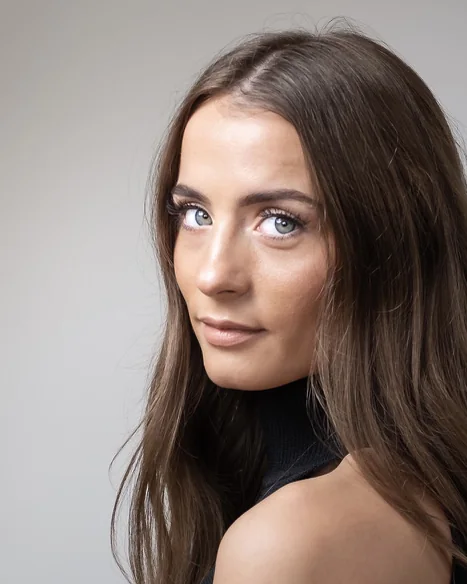
Why sets fall apart
Most firms do not decide to have inconsistent headshots. They arrive there. The London office is photographed one spring by a photographer who likes a grey backdrop and a slightly warm skin tone. The New York office is photographed the following year by someone else, on white, cooler, cropped tighter. Three partners have portraits taken for a conference by a third photographer who prefers a dark, directional look. Joiners are told to send in whatever they have. Within two years the team page has five looks on it, and the marketing team spends an afternoon a quarter cropping files to make them sit together.
None of those photographers did anything wrong. Nobody wrote down what the firm's headshot was supposed to look like, so each of them made a reasonable decision of their own.


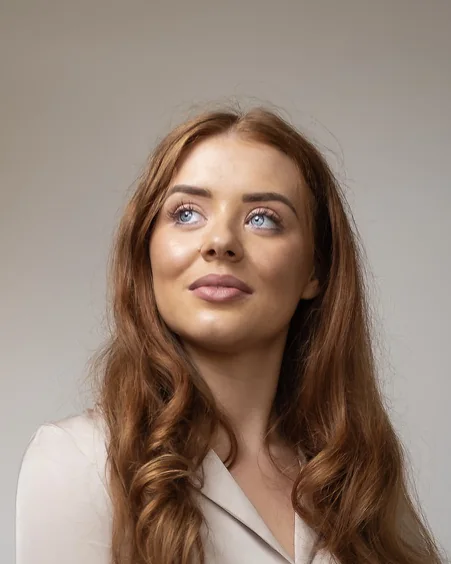

Four sittings, one Standard: backdrop tone, light and the eye line.The line is the Standard.
What a standard records
A Corporate Headshot Standard is a short document, usually two pages, that fixes the variables a photographer would otherwise choose. The lighting: how many lights, where they are, how far from the sitter, at what power, and what shapes the light. The backdrop: the material, the tone and how it is lit. The camera: the lens, the distance and the height, which together fix the perspective on a face. The framing: the crop ratios and where the eyes sit in the frame. The finishing: the contrast, the colour, the treatment of skin, and how the backdrop is matched from image to image. And a set of reference frames, kept with the document, so that a future session can be compared with the original rather than with a memory of it.
Written down, those decisions travel. Spoken, they do not.
How a standard travels to another office
A standard is a recipe, and a recipe is only useful if someone follows it exactly. In practice that means the same kit list in every office: the same lights and modifiers, the same backdrop tones, the same lens. It means a lighting diagram taped inside the flight case lid, with distances marked, so the setup in a conference room in New York is the one from the meeting room in London rather than an approximation of it. It means a test frame against the reference frame before the first person sits down, and an adjustment if the room's walls are throwing colour into the shot. And it means one finishing team, working to one profile, whoever took the photographs, because finishing is where the last differences are removed.
Where the firm's other office is photographed by an associate rather than the original photographer, the standard is the brief, and the direction comes from the person who wrote it.
How a standard travels through time
The harder problem is not the second office but the third year. Joiners arrive monthly. Partners are promoted. People ask for a refresh because they have changed their hair or their glasses or their mind. Each of those is a chance for the set to drift, and the usual outcome is that it does.
The answer is a calendar. A firm that books the same photographer four times a year, to the same standard, with the reference frames on file, never has more than a quarter's worth of joiners waiting and never has a joiner photographed by someone who did not read the document. A catch-up session for the two or three people who missed a day is matched the same way. Over several years the team page stays one set, which is what the first day was supposed to achieve.
Matching an existing set
Sometimes a firm has a set it likes and wants to keep. The standard can be written backwards from it: the backdrop tone, the crop and the finishing are measured from the existing images, the lighting is reconstructed as closely as it can be, and the first new session is compared with the old frames before it is approved. It usually works. Where it cannot, because the original was lit in a way that cannot be reproduced consistently, the honest advice is to write a new standard and refresh the set over a programme year rather than keep adding to a set that will never quite match.
What the firm should keep
The standard document, the reference frames and the name of the person who wrote it. The lighting diagram. The finishing profile. The naming convention for files. And the portal, where every person's images and status live, so that the question "who has not been photographed to the current standard" has an answer at any time.
Questions to ask any photographer
Will you write down how you lit us, and give it to us? Will you keep reference frames and compare the next session with them? Who finishes the images, and will it be the same person next year? Can you, or someone working to your document, photograph our other office the same way? What happens when we hire someone in November?
A photographer who answers all five is offering a standard. One who answers none is offering a nice set of photographs, which is a different product.
Next step: see the Quarterly Programme and Worldwide Days.